
How to Fix Inconsistent Service Documentation Across Technicians


Walk the write-up desk of any dealership service department and you'll see the same pattern: one technician's repair orders read like a warranty adjuster wrote them, with the complaint, cause, and correction laid out cleanly for all who care to look. Another tech's RO for the exact same job says "customer states noise, replaced part, ok now." Same shop, same pay plan, same training program on paper, wildly different documentation.
Quick answer: Inconsistent service documentation happens because RO write-up quality depends on each technician's individual habits, writing ability, attitude and time pressure, not on any shared process. You fix it by removing that dependency: standardize what a complete write-up must include, make it easy to follow under pressure, hold technicians to it consistently, and where possible use a guided or AI-assisted write-up tool so every RO follows the same structure regardless of who writes it.
Here's what's actually driving the inconsistency, what it costs your fixed ops department, and the fixes that work, from process changes you can start this week to the automation that makes them stick.
Why Documentation Quality Can Be Inconsistent, Often Varies From Service Technician to Technician; And How to Fix It
Inconsistent write-ups rarely come down to one bad apple. They're usually the predictable result of a few structural gaps:
No shared definition of "complete." Most shops train technicians on diagnosis and repair, not on what a warranty-ready RO narrative actually requires. Without a clear standard, every tech defaults to their own.

Writing ability isn't a hiring filter. You hire technicians for diagnostic skill and turnaround time, not for how well they write a repair story. A great tech with weak documentation habits still produces a claim-worthy repair, just not a claim-worthy write-up.
Techs get paid for speed, not documentation. When flat-rate hours reward getting to the next RO, a two-sentence write-up and a five-sentence write-up take the same amount of billed time. Detail loses to volume every time unless there's a reason not to skip it.
Tenure and turnover. Veteran techs who've been burned by a rejected warranty claim tend to write defensively and thoroughly. New hires haven't learned that lesson yet, and in a high-turnover shop, that means a rotating cast of technicians all writing at different skill levels.
No consistent review step. If nobody is checking write-up quality before an RO closes, there's no feedback loop pushing the shop toward one standard. Inconsistency just compounds. Some advisors check, but that takes them away from important customer-facing time.
None of these are character problems. They're process gaps, which is good news, because process gaps are fixable.
What Inconsistent Write-Ups Actually Cost a Service Department
It's tempting to treat thin documentation as a paperwork annoyance. In practice it shows up in the numbers that fixed ops leaders are measured on:
Warranty claims get rejected or reduced. Manufacturers and third-party administrators approve claims based on what's written on the RO, not on what the technician actually did. A correct repair with a vague story reads, to a claims reviewer, like an unsupported one.
CSI takes a hit. Customers can't see under the hood, but they can read their invoice. A generic write-up ("performed diagnosis, repaired as needed") signals a rushed job even when the work was excellent, and that perception shows up in survey scores.
Comebacks are harder to diagnose. When a vehicle returns for a related concern, the next technician is working from whatever the first one wrote. Thin documentation means re-diagnosing from scratch instead of building on what's already known.
Revenue gets delayed, not just reduced. Kicked-back claims don't disappear, they get sent back for correction, resubmitted, and re-reviewed. That's admin time and cash flow sitting in limbo that a complete write-up would have avoided the first time.
Liability exposure grows. In disputes over repeat repairs, the repair order is the record. Inconsistent documentation makes it harder for the dealership to demonstrate what was actually done.
None of this is one technician's fault, which is exactly why "write better ROs" as a one-time reminder in a shop meeting doesn't fix it. The fix has to change the system the write-up happens in.
What a Consistent, Warranty-Ready Write-Up Actually Includes
Before you can fix inconsistent service documentation technicians an d standardize documentation, everyone needs to be aiming at the same target. A complete repair order narrative should cover:
Customer's concern, in their words. Not "noise," but what the customer actually reported and under what conditions.
Cause, clearly tied to the concern. What was found, and how it explains the reported symptom.
Correction, specific enough to stand alone. What was done, which parts were used, and why that repair addresses the diagnosed cause.
Verification. How the technician confirmed the fix, road test, function check, before/after comparison.
Consistent terminology. The same job should read the same way regardless of who performed it, using language a warranty reviewer or a service advisor two months from now can follow without a phone call to the tech.
That's the bar. The question is how you get every technician, from your 20-year veteran to the tech you hired last month, to hit it on every RO.
Practical Fixes You Can Start This Week
A few changes move the needle without waiting on new software:
Give technicians a write-up template, not just a policy. A one-page reference showing a strong complaint/cause/correction example for common jobs gives techs something to model, not just a rule to remember.
Build a quick pre-close checklist. Before an RO closes, a service advisor or write-up reviewer checks it against the five elements above. Catching gaps before the customer leaves is far cheaper than catching them after a claim is rejected.
Spot-audit, then coach, don't just correct. Pull a sample of ROs weekly and review them with the technician, not to punish thin write-ups, but to show what "good" looks like using their own jobs as examples.
Make good documentation visible in your pay plan or recognition. If detailed write-ups never factor into performance conversations, don't expect behavior to change because of a memo.
These steps genuinely help. They also share the same weakness: they depend on humans remembering to follow them consistently, on a busy Friday, on the tenth RO of the day, with a line of cars still waiting. Manual process improvements tend to hold for a few weeks and then quietly erode back toward old habits, especially as staff turns over.
Why Manual Standardization Only Gets You So Far
Templates get ignored under time pressure. Checklists get skipped when the write-up desk is backed up. Coaching only reaches the technicians who are in the room for it, and it has to be repeated every time you hire someone new. None of that is a failure of effort, it's just what happens when documentation quality still depends on an individual technician remembering and choosing to follow a process, job after job, indefinitely.
The more durable fix is to take that dependency out of the equation: build the standard into the write-up process itself, so a complete, professionally worded RO is simply what happens by default, regardless of who's writing it or how busy the shop is that day.
How AI-Guided Write-Ups Solve the Root Problem
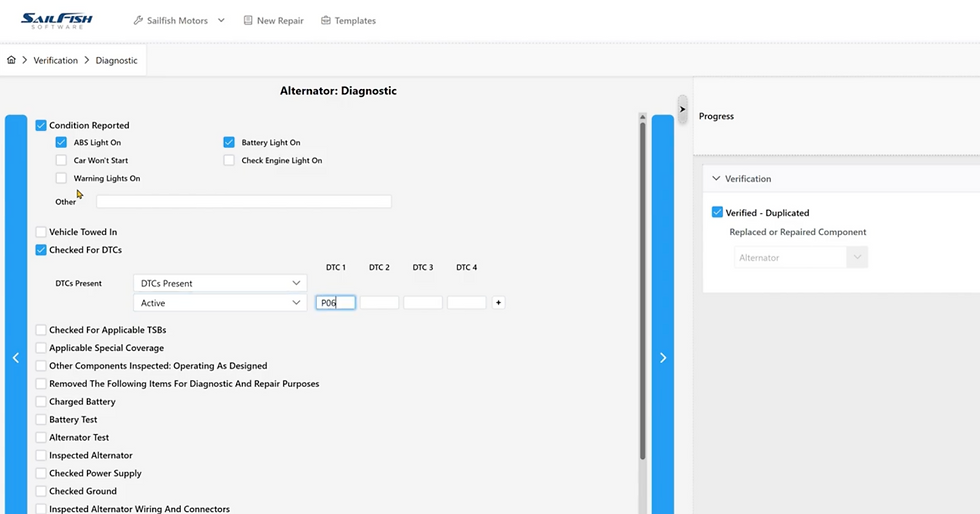
This is exactly the gap ProScribe was built to close. Instead of relying on every technician to remember a template under pressure, ProScribe guides each technician through the same structured write-up process, every time, then automatically generates a detailed, professionally written repair order narrative from their input.
That changes the consistency problem at the source:
Every RO follows the same structure, whether it's written by your most experienced tech or the person you hired last month, because the process guides the input rather than relying on memory or writing skill.
Nothing gets missed. The guided format prompts for the complaint, cause, correction, and verification details a warranty reviewer needs, so a rushed write-up doesn't mean a thin one.
Documentation quality stops being tied to how good a given technician is at writing, and starts being tied to the process, which means it holds up through turnover, busy days, and new hires.
Service managers get consistency they can actually see, in warranty approval rates, in CSI scores tied to write-up clarity, and in how quickly a service advisor or the next technician can pick up an RO and understand exactly what happened.
It's the same fix as the manual checklist, standardize what a complete write-up requires, but built into the workflow so it doesn't depend on any one person remembering to do it on any given day.
Getting Consistent Documentation Across Your Whole Shop
Inconsistent service documentation isn't a technician problem, it's a process problem, and it's fixable. Start with the basics: define what a complete write-up looks like, build a simple review step, and coach to the standard. Then close the gap that manual process alone can't close, by putting a structured, guided write-up process in place so consistency doesn't depend on any single technician's habits.
If your service department is losing warranty dollars or CSI points to write-ups that vary wildly from bay to bay, see how ProScribe standardizes repair order documentation across every technician, or book a demo to see it on your own ROs.
FAQ
Why do technicians write repair orders so differently? Because most shops never define a shared standard for what a complete write-up includes. Without one, documentation quality tracks each technician's individual writing habits, experience, and how much time pressure they're under, not a consistent process.
What should be included in every repair order write-up? At minimum: the customer's concern in their own words, the diagnosed cause, the correction performed, how the repair was verified, and consistent terminology so the RO reads the same way regardless of who wrote it.
How does inconsistent documentation affect warranty claims? Claims administrators approve or reject based on what's written, not on what was actually done. A correct repair with a vague or incomplete write-up is far more likely to be rejected or reduced than one with a detailed, well-supported narrative.
Can training alone fix inconsistent write-ups? Training helps, but it tends to fade under day-to-day time pressure and doesn't automatically transfer to new hires. Lasting consistency usually requires building the standard into the write-up process itself, through templates, review steps, and guided or AI-assisted tools, rather than relying on training alone.


Comments